
Abstract
Outdoor network coverage limitations have long plagued remote residential areas, industrial sites, temporary construction projects and unattended monitoring stations, as traditional indoor routers fail to adapt to harsh outdoor environments and weak base station signal conditions. 5G outdoor CPE Router adopts industrial-grade hardware design, high-gain MIMO antenna technology and dual-band Wi-Fi 6 architecture to stably convert 5G NR and LTE cellular signals into reliable wired and wireless local network coverage for all outdoor scenarios. Featuring wide temperature adaptability, full-sealed waterproof and dustproof performance, and multi-protocol remote management functions, this device solves the pain points of unstable outdoor network connectivity and difficult remote equipment maintenance. This article comprehensively introduces its structural design, hardware composition, global frequency band compatibility, application scenarios, deployment specifications and security mechanisms, providing professional and systematic guidance for outdoor cellular network construction and long-term stable operation.
Table of Contents — Click Any Link Below To Jump To Corresponding Chapter Section
- 1. Core R&D Design Concepts Optimized For Long-Term Open-Air Operation
- 2. Complete Internal Hardware Module Composition And Signal Transmission Logic
- 3. Full Standardized Technical Parameter Reference Comparison Table
- 4. Global Regional Frequency Band Compatibility And Differentiated Model Selection Rules
- 5. Diverse Outdoor Working Scenarios Suitable For Cellular Outdoor Gateway Deployment
- 6. Stepwise On-Site Installation And Signal Debugging Standard Operating Procedures
- 7. Multi-Layer Network Security Control Mechanisms Built Into The Gateway System
- 8. Frequently Asked Technical And Deployment Questions With Detailed Answers
- 9. Customized Function Expansion Solutions For Specialized Industrial Networking Demands
1. Core R&D Design Concepts Optimized For Long-Term Open-Air Operation
All hardware design iterations for outdoor cellular gateways revolve around two core targets: all-climate environmental durability and long-distance high-gain cellular signal reception, two core weaknesses that consumer indoor routers cannot overcome. Ordinary household wireless equipment is only designed for stable indoor temperature and dust-free environments; once exposed to outdoor rain, frost, strong ultraviolet radiation and industrial dust, internal circuit boards will quickly corrode, antenna signal attenuation will increase sharply, and sustained high-speed data transmission cannot be guaranteed. Engineers optimize every structural detail of outdoor cellular gateways to adapt to complex and changeable open-air environments, balancing stable signal capture capability and long service cycle without frequent equipment replacement.
1.1 IP-Class Sealed Waterproof And Dustproof External Shell Architecture
The outer shell of the gateway adopts integrated injection molding and fully sealed rubber ring sealing technology, forming a complete dustproof and rainproof protective layer for all internal electronic components. The overall structure avoids open heat dissipation holes that allow rainwater and fine industrial dust to penetrate the interior; heat dissipation is realized through integral metal heat-conducting fins distributed on the back mounting bracket, transferring the heat generated by the chip to the external air through contact conduction without opening gaps that damage sealing performance. This fully sealed design allows the equipment to run continuously under heavy rain, seasonal snowfall and high-humidity coastal fog environments without short circuit or signal circuit corrosion failure.
The shell material selects high-strength anti-UV engineering plastic, which can resist long-term direct sunlight exposure without yellowing, brittleness or structural cracking. For deployment sites close to coastal saltwater areas, the surface also adds anti-salt spray coating to slow down the oxidation rate of metal accessories such as mounting brackets and antenna interfaces, extending the complete functional service cycle of the equipment under high-salinity air conditions.
1.2 Ultra-Wide Temperature Adaptation Circuit Board Design
Outdoor deployment sites face extreme temperature fluctuations all year round, from low-temperature freezing environments below minus ten degrees Celsius in winter to high-temperature exposure above sixty degrees Celsius under direct summer sunlight. Conventional circuit board components will trigger automatic frequency reduction or shutdown protection when exceeding narrow temperature thresholds, resulting in intermittent network disconnection of outdoor monitoring equipment and terminal devices. The industrial-grade chip solution built into the outdoor cellular gateway supports stable operation within a wide temperature range from -10°C to 75°C, with reserved storage temperature range down to minus 40°C for long-term shutdown storage in cold areas.
All electronic components on the main board adopt wide-temperature resistance industrial grade specifications, including power management chips, signal receiving radio frequency modules and memory storage chips. Even under continuous high-temperature sunlight irradiation, the chip will not produce abnormal frequency drop, and the cellular signal receiving sensitivity can remain at the factory calibrated standard value without attenuation, ensuring uninterrupted data transmission of outdoor monitoring cameras, POS terminals and industrial data collection equipment connected to the network.
1.3 Built-In High-Gain MIMO Antenna Array For Long-Distance Base Station Signal Capture
The internal integrated multi-group MIMO cellular antenna layout is another core design difference separating professional outdoor cellular gateways from ordinary indoor routers. Indoor wireless equipment only configures low-gain built-in antennas for short-distance indoor signal coverage, which cannot capture weak cellular signals from distant base stations blocked by buildings, hills and vegetation. The outdoor gateway embeds 4 groups of 4*4 MIMO 5G NR antennas and 4 groups of MIMO LTE antennas, matched with 28dBi high gain, which can effectively receive weak base station signals in remote suburban, mountainous and rural areas with sparse base station layout.
Dual-layer antenna isolation layout is adopted inside the shell to avoid mutual signal interference between 5G NR cellular receiving antenna and Wi-Fi transmitting antenna. Independent shielding metal partitions separate radio frequency signal transmission areas and local area network signal coverage areas, reducing crosstalk interference between uplink cellular signal reception and downlink wireless coverage emission, maintaining stable high-speed upload and download throughput even when multiple terminals access the network simultaneously for high-definition video streaming and large file transmission tasks.
2. Complete Internal Hardware Module Composition And Signal Transmission Logic
The entire outdoor cellular gateway equipment is assembled from six core independent functional modules, each undertaking a fixed link in the whole signal conversion workflow from cellular base station signal receiving to local wired and wireless network output. Every hardware unit undergoes independent aging testing before assembly, and the whole machine completes continuous 72-hour full-load transmission testing to eliminate hidden signal instability faults caused by module matching deviation after leaving the factory.
- Main control chip platform module: Adopts MTK T750 industrial main control chip, matched with MT6890 radio frequency modem, providing core computing power for 5G NR signal demodulation, routing data forwarding and wireless network management
- Cellular radio frequency receiving antenna module: Internal 4*4 MIMO 5G NR antenna array and 4*4 MIMO LTE antenna group, responsible for capturing uplink cellular signals from remote operator base stations
- Dual-band AX3000 Wi-Fi coverage module: Integrates 2.4GHz and 5GHz dual-band independent antenna groups, converts processed cellular network data into local wireless Wi-Fi signal for terminal access
- Wired Ethernet interface transmission module: Contains 1*2.5G WAN/LAN adaptive port and 3*Gigabit LAN ports, supporting stable wired high-speed connection of monitoring equipment, industrial controllers and desktop terminal devices
- Power management and indicator light module: Industrial wide-voltage power supply circuit, with independent LED indicator lights for 5G network status, LTE signal, dual-band Wi-Fi and equipment running state
- Remote management and configuration storage module: Built-in storage chip supporting configuration file local storage, matching WEB local management background and TR069 remote unified management protocol
2.1 Complete Signal Conversion Workflow Sequence
The full signal transmission process starts from the built-in high-gain antenna receiving cellular signals sent by operator base stations. After the radio frequency module demodulates analog cellular signals into digital data streams, the main control chip completes routing scheduling, QoS bandwidth allocation and network security filtering processing, then distributes the processed data streams to two output channels simultaneously. One channel transmits data to wired terminal equipment through the Gigabit and 2.5G Ethernet ports on the bottom of the shell; the other channel converts digital data into dual-band Wi-Fi wireless signals through the AX3000 wireless module, covering surrounding terminal equipment such as mobile phones, tablets and wireless monitoring cameras within the signal radiation range.
When terminal equipment uploads local data to the operator cellular network, the workflow reverses completely: wired or wireless terminal upload data is collected by the gateway, processed by the main control chip for data packaging and frequency band matching, and then transmitted back to the operator base station through the built-in MIMO cellular antenna array, realizing two-way interactive data transmission between local outdoor terminals and remote cloud servers.
2.2 Matching Auxiliary AX3000 Wireless Access Point Hardware
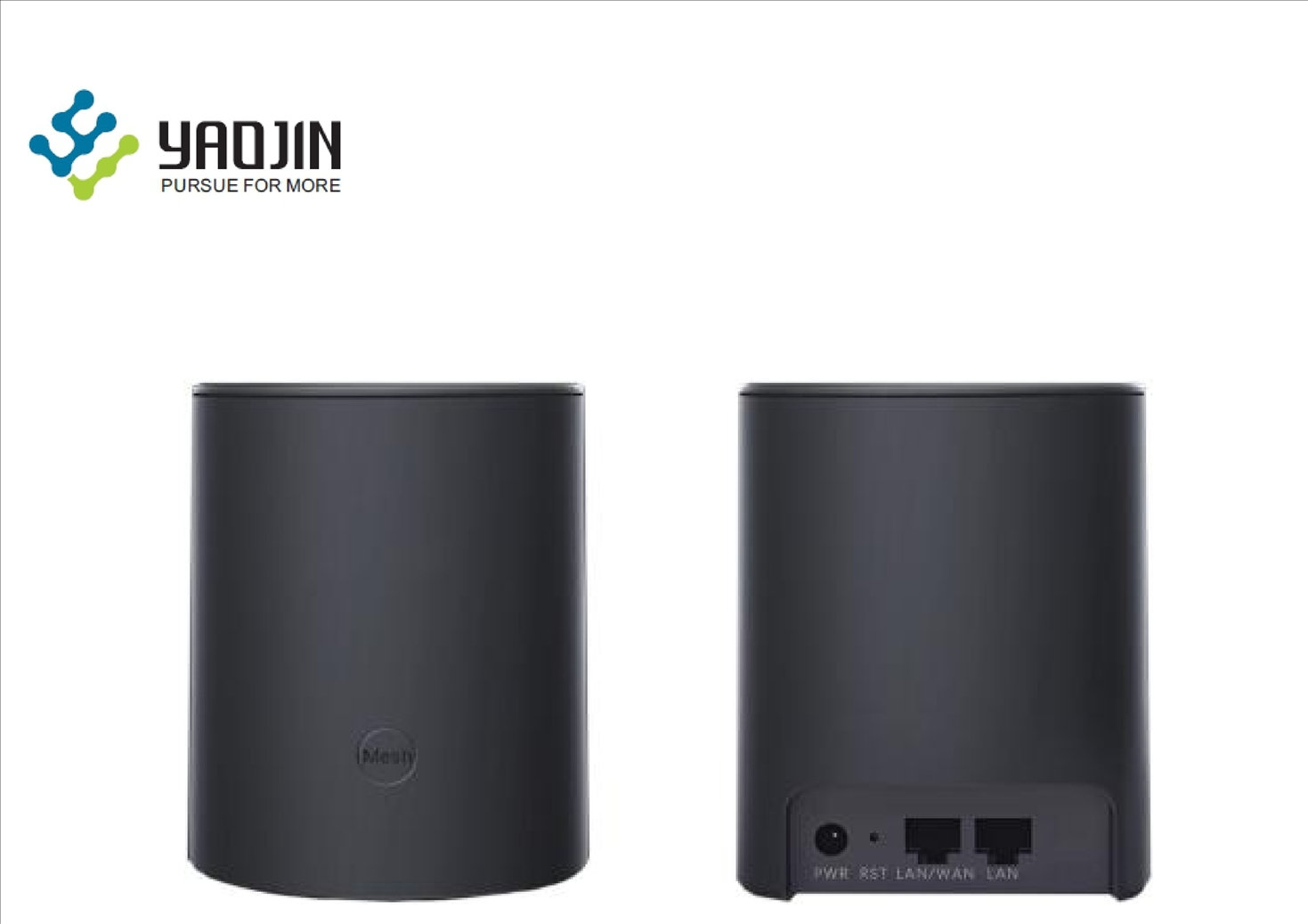
The complete supporting set of the gateway includes an independent AX3000 indoor wireless router, which serves as an extended coverage access point for local indoor or semi-open areas such as store interiors, temporary office containers and monitoring equipment control rooms. The outdoor cellular gateway is responsible for long-distance cellular signal reception and primary data forwarding, while the matching AX3000 AP expands uniform dual-band Wi-Fi coverage in short-distance local areas, solving the problem of weak wireless signal attenuation caused by wall barriers between the outdoor gateway installation position and indoor terminal equipment. The two devices support automatic signal linkage deployment, unified network name configuration and seamless terminal roaming switching without manual repeated network access operations.
On-site installers often combine this gateway with wireless access points for sites split between outdoor signal receiving locations and indoor working zones. Such combined deployment avoids the common flaw of relying solely on the gateway’s built-in Wi-Fi, which struggles to penetrate thick concrete walls or metal enclosures. Reasonable layout of access points ensures every connected terminal receives consistent network speed without obvious latency fluctuations.
3. Full Standardized Technical Parameter Reference Comparison Table
Stable performance relies on standardized hardware specifications. Before planning any networking project, reviewing official technical parameters helps avoid mismatched hardware selections and unsatisfactory on-site network results. Every specification is verified through laboratory closed environment testing and open-air field signal testing, complying with global cellular communication industry hardware design standards, and can be used as objective reference data for engineering deployment technicians, industrial networking procurement teams and site signal planning personnel to complete equipment selection and scheme formulation.
| Testing Classification Item | Standard Verified Technical Parameter Index |
|---|---|
| Main Control Chip Platform | MTK T750, Matched MT6890/AZA 2.0GHz Modem |
| 5G NR & LTE Antenna Configuration | Internal 4*4 MIMO 5G NR Antennas; Internal 4*4 MIMO LTE Antennas, Max Gain 28dBi |
| Peak Cellular Download & Upload Throughput | NSA 4.67Gbps Download / 625Mbps Upload; LTE 1.6Gbps Download / 211Mbps Upload; WCDMA 42.4Mbps Download / 5.76Mbps Upload |
| Wi-Fi Wireless Standard Specification | IEEE 802.11ax AX3000 Dual Band Wi-Fi 6 |
| Wi-Fi Antenna Layout | Internal 2*2 2.4GHz Antennas, Internal 3*3 5GHz Antennas |
| Physical Wired Interface Layout | 1×2.5G WAN/LAN Adaptive Port, 3×Gigabit LAN Ports, Power Input Port, SIM Card Slot, Reset Button |
| Supported Network Connection Modes | Bridge Mode, Router Mode, NAT Mode; Static/DHCP/PPPoE Connection Protocol |
| Built-In Network Security Functions | Hardware Firewall, DOS Attack Defense, Port Scan Interception, MAC Address Filtering, Multi-Level VPN Tunnel Support |
| Remote Network Management Protocols | Local WEB Management, TR069 Remote Unified Management, Universal Plug and Play Configuration |
| Official Operating Temperature Range | -10℃ to +75℃ Continuous Stable Operation |
| Equipment Storage Temperature Range | -40℃ to +70℃ Long-Term Shutdown Storage |
| Environmental Humidity Adaptation Standard | 5% to 95% Non-Condensing Relative Humidity |
| Built-In Status Indicator Light Classification | 5G NR Signal Indicator, 4G LTE Indicator, 2.4G Wi-Fi Indicator, 5G Wi-Fi Indicator, Equipment Power Running Indicator |
Every data threshold in the table represents the minimum stable performance standard that finished products must reach before leaving the factory. Any equipment batch failing to pass the full-index aging test cannot be delivered for outdoor engineering deployment, to avoid unstable network transmission faults on construction sites, remote monitoring stations and retail cluster deployment projects caused by substandard hardware parameters.
4. Global Regional Frequency Band Compatibility And Differentiated Model Selection Rules
Different regional communication regulatory authorities divide independent cellular frequency bands for 5G NR and LTE network operation, so three differentiated hardware model versions are developed to match signal spectrum standards in Europe, North America and Latin America respectively. Each version locks the corresponding frequency band receiving and transmitting radio frequency circuits to ensure maximum signal receiving sensitivity for local operator base station signals, avoiding signal loss or throughput reduction caused by mismatched frequency band hardware.
4.1 Core Frequency Band Matching For Three Main Regional Model Variants
- A830M-EU European Version: Supports mainstream EU 5G NR n1/n3/n5/n7/n8/n20/n28/n38/n40/n41/n77/n78 bands; LTE FDD 800/850/900/1700/1800/2100/2600, LTE TDD 38/40/41/42/43, WCDMA B1/B2/B5/B8
- A830M-NA North American Version: Matches North America 5G NR n2/n5/n7/n12/n14/n25/n26/n38/n40/n41/n77/n78; LTE FDD 817/850/1700/1900/2100/2600, LTE TDD B38/B40/B41/B42/B43, WCDMA B2/B4/B5
- A830M-LA Latin American Version: Covers Latin America 5G NR n2/n5/n7/n12/n25/n26/n38/n40/n41/n77/n78; LTE FDD 824/850/1710/1900/2600, LTE TDD B38/B42/B43, WCDMA B2/B4/B5
When carrying out cross-regional outdoor networking deployment projects, engineering technicians must select the corresponding regional model variant according to the local mainstream operator’s operating frequency bands. If the frequency band version is mismatched, the gateway cannot fully lock the optimal cellular signal channel of local base stations, which will lead to low signal reception strength, frequent network disconnection and failure to reach the peak download and upload throughput marked in the parameter table.
4.2 SIM Card And Operator Network Access Configuration Notes
The equipment reserves a standard 6PIN SIM card slot at the bottom of the shell, supporting all mainstream operator cellular data SIM cards, industrial IoT dedicated traffic cards and unlimited broadband data cards. Before inserting the SIM card, power supply must be cut off completely to avoid radio frequency circuit short circuit caused by static electricity during card insertion and removal. After inserting the SIM card and restoring power supply, the gateway will automatically search surrounding cellular base station signals according to the pre-locked frequency band of the model version, and users can complete manual signal band locking and priority network switching configuration through the local WEB management background to optimize signal stability for deployment sites with mixed coverage of multiple frequency bands.
5. Diverse Outdoor Working Scenarios Suitable For Cellular Outdoor Gateway Deployment
The all-climate sealed shell, wide temperature operating range and long-distance high-gain antenna reception capability expand the applicable deployment scope of the outdoor cellular gateway to almost all open-air sites lacking fixed optical fiber wired network access. All deployment environments share the same core demand: stable high-speed two-way data transmission without relying on buried optical fiber cable infrastructure laid in advance.
5.1 Rural Remote Residential Cluster Broadband Coverage
Many scattered rural settlements, mountain villages and remote suburban communities cannot obtain optical fiber wired network access due to high cable laying construction costs and long-distance terrain obstacles. Installing the outdoor cellular gateway on the outer wall or roof of central residential buildings can receive distant town base station 5G signals, convert them into unified wired and wireless network coverage to supply multiple households with simultaneous broadband access, realizing high-definition video playback, remote office and online learning data transmission demands without optical fiber wiring construction.
5.2 Temporary Construction Site Network Support
Large infrastructure construction projects including highway engineering, hydropower station construction and real estate development sites only require temporary network support during the construction cycle, and optical fiber laying and post-demolition recovery will generate unnecessary extra construction workflows. The outdoor cellular gateway can be quickly installed on temporary container office exteriors, construction tower cranes and monitoring support frames, providing uninterrupted network access for construction management terminals, high-definition construction monitoring cameras and engineering real-time data collection equipment throughout the whole construction period.
5.3 Offline Retail Stores And Outdoor Service Booth Networking
Roadside retail stalls, outdoor catering booths, temporary exhibition booths and scattered suburban convenience stores often lack fixed optical fiber access conditions. Deploying the outdoor cellular gateway on the outer wall of store buildings provides stable network support for cash register POS data upload, customer wireless Wi-Fi access and store security monitoring camera real-time video backhaul, solving the problem of unstable network of consumer-grade portable hotspots under continuous multi-terminal concurrent access pressure.
5.4 Remote Industrial Monitoring And Environmental Data Collection Stations
Mountain meteorological monitoring stations, reservoir water quality detection equipment, forest fire prevention monitoring cameras and mineral resource industrial data collection terminals are mostly arranged in uninhabited remote areas without wired network infrastructure. The outdoor cellular gateway operates continuously all year round under complex outdoor climate conditions, transmitting real-time environmental monitoring data, video stream signals and equipment operation state information back to central industrial cloud platforms through 5G cellular networks, realizing unattended remote monitoring and abnormal data early warning functions.
5.5 Temporary Outdoor Event And Mobile Office Vehicle Networking
Large outdoor exhibitions, sports events, field news interview vehicles and mobile emergency command vehicles need rapid deployable mobile network support without fixed wiring construction. The lightweight wall-mounted bracket design of the gateway allows quick temporary installation on vehicle outer walls, temporary exhibition stand frames and mobile command box surfaces, instantly establishing high-speed local area networks for on-site staff office, live video streaming and event real-time data statistical transmission.
6. Stepwise On-Site Installation And Signal Debugging Standard Operating Procedures
Standardized layered installation and signal debugging steps can maximize the cellular signal receiving strength of the equipment, avoiding signal shielding caused by unreasonable installation position selection and bracket fixing angle errors, which will reduce overall network throughput stability. The complete operation sequence is divided into six independent execution stages from pre-installation preparation to post-deployment signal optimization.
- Stage 1. Pre-installation site signal survey: Use portable signal testing equipment to measure the signal strength of surrounding 5G NR and LTE frequency bands at multiple candidate installation positions on walls, roofs and support frames, record the position with the strongest base station signal as the fixed installation point
- Stage 2. Bracket fixed mounting operation: Fix the matching metal wall-mounted bracket to the selected installation surface with expansion bolts, ensure the bracket keeps horizontal without tilt to avoid the built-in antenna array being shielded by metal wall structures
- Stage 3. Equipment assembly and SIM card insertion: Cut off power supply completely, open the bottom sealing cover, insert the matched operator data SIM card into the card slot, tighten the waterproof sealing cover to ensure complete rainproof sealing of the interface area
- Stage 4. Power connection and initial boot self-test: Connect the factory-matched power adapter to the power interface, switch on power supply, observe the LED indicator light sequence to complete automatic boot hardware self-test, wait 2 to 3 minutes for the gateway to automatically search surrounding cellular base station signals
- Stage 5. Local WEB background signal optimization configuration: Connect a laptop to the Gigabit LAN port of the gateway, log into the local management page, lock the optimal signal frequency band detected on site, adjust QoS bandwidth allocation rules according to terminal concurrent access quantity
- Stage 6. Post-deployment full-load stability testing: Connect all wired and wireless terminal equipment that need to access the network simultaneously, run continuous large-file upload and download testing for 2 hours, confirm no signal disconnection or throughput sharp drop under full concurrent load before completing the whole deployment process
If the measured cellular signal strength of the selected installation position is still weak after debugging, the installation height can be raised appropriately to avoid metal buildings, dense tree canopies and hills blocking the straight-line propagation path between the gateway antenna and operator base stations. Metal barriers produce severe signal reflection and attenuation interference, which is the primary cause of low signal reception rate for most outdoor gateway deployment sites.
7. Multi-Layer Network Security Control Mechanisms Built Into The Gateway System
Outdoor network deployment sites involve industrial monitoring data, store transaction information and resident private network access data, so the gateway embeds multi-dimensional layered security defense functions to prevent illegal network intrusion, data theft and malicious bandwidth occupation attacks from external cellular network terminals. All security control functions are built into the hardware chip level rather than simple software plug-ins, maintaining stable defense performance even under long-term continuous full-load operation.
7.1 Hardware Firewall And Malicious Attack Interception System
The built-in industrial-grade hardware firewall independently filters all data packets transmitted between the cellular wide area network and local wired/wireless local area network, automatically identifying and intercepting common network attack behaviors including DOS flood attacks, port scanning intrusion and abnormal data packet blasting. The firewall supports custom access control rule editing through the WEB management background, allowing deployment technicians to restrict external network access permissions of local industrial monitoring terminals and store transaction equipment according to actual site security management demands.
7.2 Multi-Level Encrypted Wireless Access Security Rules
The dual-band AX3000 Wi-Fi module supports full mainstream wireless encryption protocols including WPA2, WPA3, WPA Mixed and WEP encryption modes, and supports hidden wireless network name broadcasting function to avoid automatic scanning capture by surrounding unknown mobile terminals. Administrators can set independent access passwords for 2.4GHz and 5GHz frequency bands respectively, and configure MAC address whitelist filtering rules to limit only authorized terminal equipment to connect to the local wireless network, preventing unauthorized external personnel from occupying network bandwidth or accessing internal private monitoring data.
7.3 Virtual Private Network Tunnel Support For Remote Data Isolation
The gateway reserves multi-channel VPN tunnel protocol support, allowing remote management personnel to establish encrypted isolated data transmission channels between outdoor local area networks and central office cloud management platforms. All industrial monitoring data and site operation information transmitted through the VPN tunnel are fully encrypted during transmission on the cellular wide area network, eliminating the risk of core business data leakage during long-distance wireless signal transmission between outdoor sites and central control rooms.
8. Frequently Asked Technical And Deployment Questions With Detailed Answers
9. Customized Function Expansion Solutions For Specialized Industrial Networking Demands
Different industrial outdoor networking projects put forward differentiated personalized function expansion demands according to site monitoring types, terminal access quantity and remote management modes, requiring targeted hardware and software function adjustment of the cellular gateway equipment on the basis of retaining core 5G signal conversion performance. Yaojin Technology provides customized function modification schemes for all kinds of outdoor industrial networking clients, adjusting auxiliary software management modules and reserved expansion interfaces without changing the core cellular radio frequency receiving and transmission hardware that complies with global communication industry standards.
9.1 Optional Customizable Function Expansion Items For Engineering Deployment Projects
- Custom pre-configured operator frequency band locking files for regional exclusive base station signal matching, simplifying on-site debugging operation steps for construction technicians
- Extended multi-channel VPN tunnel protocol pre-installation for industrial park multi-site interconnection and cross-regional encrypted data transmission demands
- Customized WEB management background brand interface modification, including enterprise exclusive logo display and simplified operation menu for on-site staff quick configuration
- Additional industrial serial port expansion module matching for special equipment data collection terminals with RS485 serial communication transmission demands
- Customized remote alarm push function configuration, sending equipment offline and signal abnormality reminder information to designated management terminal equipment in real time
All customized modified equipment versions retain the complete original machine core hardware performance including wide-temperature circuit board, high-gain MIMO antenna array and full waterproof sealed shell structure. No modification operations will reduce the peak cellular throughput, environmental durability or signal receiving sensitivity standard of the finished product; all customized adjustment contents only target auxiliary management software and optional external expansion interfaces, and will not affect the core communication hardware modules regulated by global cellular communication certification standards.
Acquire Targeted Outdoor Cellular Networking Deployment Technical Support
All industrial construction teams, rural broadband planning institutions and retail cluster operation management departments can obtain exclusive professional technical consultation, complete equipment deployment scheme planning and personalized function expansion modification guidance matching unique site networking demands. Pre-evaluation physical sample supply service is not supported for demand verification, while complete official technical specification data sheets, regional frequency band matching documents and standard installation operation manuals can be delivered directly to internal engineering and safety management departments for scheme review and construction preparation work.
contact us